Learning Outcomes:
i. Define classical conditioning and explain its role in shaping learned behavior.
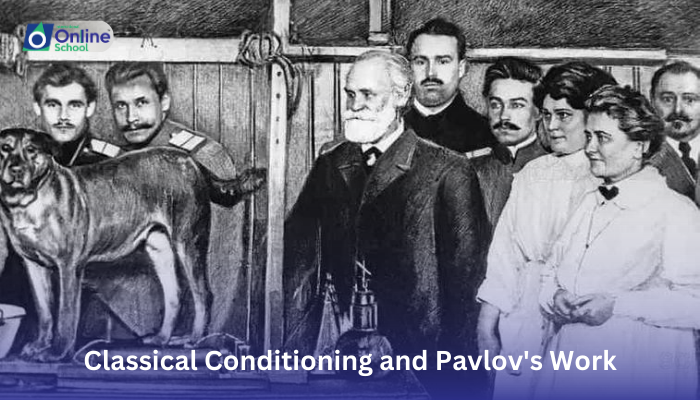
ii. Understand the work of Ivan Pavlov and his experiments on the salivary reflex in dogs.
iii. Identify the key elements of classical conditioning: unconditioned stimulus, conditioned stimulus, and conditioned response.
iv. Appreciate the power of conditioning in shaping our own responses and understanding others' behavior.
Introduction:
Imagine a world where every sound, every sight, triggered a predictable reaction. This, in essence, is the world of classical conditioning, a fascinating phenomenon where we learn to associate seemingly unrelated stimuli. In this lesson, we'll step into the laboratory of Ivan Pavlov, the man who led the orchestra of learning and unraveled the melody of conditioned responses.
i. The Drooling Dogs: Pavlov's Experiment
Picture a hungry dog, its mouth watering at the sight of food. This is an unconditioned stimulus, a natural response that doesn't require any learning. Now, imagine pairing this food with the sound of a bell, ringing it repeatedly just before presenting the meal. Initially, the bell triggers no reaction. But over time, as the bell and food are repeatedly paired, something remarkable happens. The dog starts to salivate at the mere sound of the bell, even before the food appears. This is the essence of classical conditioning: a neutral stimulus (the bell) becomes associated with an unconditioned stimulus (food), leading to a learned response (salivation).
ii. The Concerto of Conditioning: Key Elements
Pavlov's experiment highlighted the key elements of classical conditioning:
Unconditioned Stimulus (UCS): The stimulus that naturally triggers a response (food in Pavlov's case).
Unconditioned Response (UCR): The natural response to the UCS (salivation in Pavlov's case).
Conditioned Stimulus (CS): The neutral stimulus that becomes associated with the UCS through repeated pairing (the bell in Pavlov's case).
Conditioned Response (CR): The learned response to the CS that mimics the UCR (salivation in Pavlov's case).
iii. The Symphony of Learning: Beyond the Lab
Classical conditioning isn't confined to the laboratory. It shapes our everyday experiences. Imagine a child who associates the doctor's white coat with a painful injection. The coat, once a neutral stimulus, becomes a CS, triggering fear (the CR) due to its association with the pain (UCS). Similarly, a pleasant song paired with a delicious meal might make us crave the food even months later, the song acting as a CS triggering the CR of craving.
Pavlov's work on classical conditioning opened a window into the fascinating world of learned behavior. It showed us how our experiences shape our responses, how seemingly unrelated stimuli can become linked, and how our internal orchestra of reactions is constantly being influenced by the melodies of the environment. So, the next time a familiar tune triggers a specific feeling, or a particular smell brings back a vivid memory, remember the echoing notes of Pavlov's orchestra, reminding us that our own behavior is a symphony composed of learned and unlearned responses, a beautiful testament to the power of experience in shaping who we are.
